

A Buyer’s Guide to Personalised Workwear for Construction Teams
Kitting out a construction team properly is one of those jobs that looks simple until you actually start the process. Sizing, fabric choices, logo placement, lead times and reorder logistics all start to add up, and most firms make a few expensive mistakes the first time round.
The aim of this guide is to save you some of that trouble by walking through what actually matters when you are buying personalised workwear for a working crew.
Key considerations before you order personalised workwear
Construction workwear has to handle conditions that ordinary clothing simply will not survive. Before placing an order, it is worth running through the basics that separate a decent kit from the pieces that end up in the bin within a few months.
- Durability: Look for reinforced seams, triple-stitched stress points and heavier fabric weights. A 65 percent polyester and 35 percent cotton blend is a common workhorse that holds up well against site abrasion while staying comfortable over a full shift.
- Weather suitability: A British construction year covers everything from heatwaves to driving rain, so plan for both. Moisture-wicking fabrics earn their place in summer, while softshell jackets and gilets layer well for the colder months.
- Functionality: Secure pockets for tools, elasticated or gusseted waistbands for movement, and articulated knees on work trousers all earn their place on a working site.
- Compliance: If your team works on roads, rail or any environment where visibility is required, factor in hi-vis layers that meet the relevant standards from day one.
Sizing and fit, the part most firms get wrong
The single biggest reason construction workwear ends up unworn is poor fit, and the single biggest reason for poor fit is rushing the sizing audit. Before you order anything, get accurate measurements from every member of the team rather than relying on “I’m a medium” answers, because sizes vary considerably between brands.
It is also worth thinking about layering when you size. A jacket that fits over a t-shirt may be too tight over a hoodie, so account for what the garment will actually sit on top of in winter. Ordering one or two sample sizes in your most common style first is a sensible step for any team larger than ten, since it gives you something to try on before committing to a full order.
Essential personalised workwear for a construction team
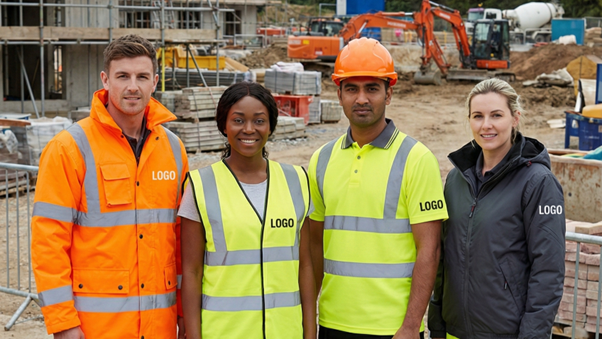
Most construction teams build their workwear around a small core of staples, with extras added depending on the trade and the time of year. The list below covers the pieces that earn their place on almost every site.
- Polo shirts and workwear t-shirts: The daily workhorses, worn in warmer weather and as base layers in winter. Choose breathable fabrics since they will see a lot of use and a lot of washes.
- Workwear hoodies and sweatshirts: Sit on top of that base layer for cooler mornings and shoulder-season days, and double as the most-worn garment for many crews.
- Softshell jackets and gilets: A flexible, water-resistant option for unpredictable British weather. A heavier waterproof jacket is worth holding in reserve for the wet months.
- Workwear shorts: A more common addition to the summer kit list now, particularly for groundworkers and labourers who feel the heat.
- Work trousers: Ideally with kneepad pockets, secure tool pockets and a hard-wearing fabric blend.
- Hi-vis layers: If your team works on roads, rail or any environment where visibility is required, add a hi-vis vest, polo or jacket on top of the standard kit.
Sticking to high quality brands like Uneek workwear for the core staples is one practical way to keep fit and styling consistent across the team.
Choosing the right personalisation method
The two main ways of branding workwear are embroidery and print, and the right choice depends on the garment and the design.
Embroidered workwear has a premium look and tends to last the working life of the garment, which makes workwear embroidery the standard choice for polo shirts, hoodies, softshell jackets and gilets. The thread sits into the fabric rather than on top of it, so it survives industrial washing far better than print.
Printed workwear has its own strengths, particularly for high-vis garments where embroidery is not always practical, for t-shirts in larger volumes, and for complex or multi-colour logos that would be expensive to digitise for embroidery. It is also generally the more cost-effective option on large simple orders. A good supplier will recommend the right method for each garment in your order rather than defaulting to one across the board.
How to choose the right personalised workwear supplier
The supplier you choose will affect almost every part of the experience, from artwork quality to delivery times and the ease of placing reorders.
Look for a supplier with in-house branding rather than one that outsources the embroidery or print, since in-house production gives you better quality control and usually faster turnaround. Ask about minimum order quantities, lead times for first orders versus reorders, and whether they hold your logo and team sizing on file for future top-ups.
It is also worth asking about samples and proofs. A good supplier will send a digital proof of your logo on each garment style before going to production, and will hold off on the order until you approve it in writing. When you are choosing the right personalised workwear supplier, that proofing step is the single best protection against expensive artwork mistakes.
Buying strategy, bundles and managing reorders
For a new kit-out, workwear bundles often work out cheaper than buying garments individually, and they make life easier for HR or operations when kitting out new starters. A standard pack of workwear with a logo can be handed over on day one, rather than building a bespoke order every time someone joins the team.
It is also sensible to order spares of common sizes when you place your first order, so a new starter can be in branded workwear on their first morning rather than waiting two weeks for a reorder. Setting up a shared spreadsheet with sizes, garment codes and supplier contact details takes minutes to put together and saves hours the next time around.
Common mistakes to avoid when buying personalised workwear
A handful of mistakes come up again and again on a first workwear order. None of them are dramatic on their own, but they add up to wasted spend and pieces nobody wants to wear.
- Going too cheap on fabric: Low-quality construction work clothes wear through within months and need replacing far sooner than decent kit, which usually works out more expensive overall.
- Skipping the sizing audit: This leads to returns, ill-fitting garments and the awkwardness of staff turning up in kit that simply does not suit them.
- Inconsistent branding: A logo that appears in three slightly different sizes or positions across the team looks scrappy on site. Lock your artwork specifications with your supplier before production starts.
- Approving artwork without proof: Always ask for a digital proof of your logo on each garment style before going to production, and approve it in writing.
- Ignoring comfort: Workers who find their kit hot, scratchy or ill-fitting will leave it in the van, which defeats the point of buying branded workwear in the first place.
Getting personalised construction workwear right the first time
Getting workwear right is one of those jobs that pays back over years rather than weeks. A well-chosen first order, with the right fabrics, the right fit and the right branding, sets a tone for how the team presents itself on site and how long the kit lasts in service.