

Enclosures for concrete: streamlining electrical installation to meet demanding construction schedules
Chris Lloyd, Managing Director of Spelsberg UK, explains the keys to successful enclosure use in concrete construction.
Enclosures for concrete: streamlining electrical installation to meet demanding construction schedules
The government’s new homes and construction initiatives mean that speed of development is essential. To achieve these goals, concrete is playing an important role, with off-site manufacturing optimising efficiency. Across all building developments, fast and secure electrical installation is fundamental, but when working with concrete, effective and reliable integration of electrical enclosures and conduits is an even more important process.
To support the government’s pledge of building 1.5 million new homes by 2029, speed is of the essence. This is a key reason for the impetus behind Modern Methods of Construction, or MMC, which is pushing the growth of off-site manufacturing and modular construction into the house building market. While prefabricated construction is a decades-old concept, MMC adds Building Information Modelling (BIM) and digital design techniques to achieve high-quality, precision manufactured modules and panels.
Key to this approach is the reliance on concrete. While building with concrete is a tried-and-tested approach, today’s mix can achieve stronger and lighter structures, and with a more sustainable outcome. To achieve the potential of the MMC concept, pre-cast concrete panels and modules deliver more precise and consistent production with the controlled environment of a factory, and this setting is also the ideal time to integrate the essential electrics. Adding conduits, ducts, and terminals within the pre-cast concrete structure makes electrical installation, and hence the overall build, a much faster and more efficient process.
Pre-fabricated concrete
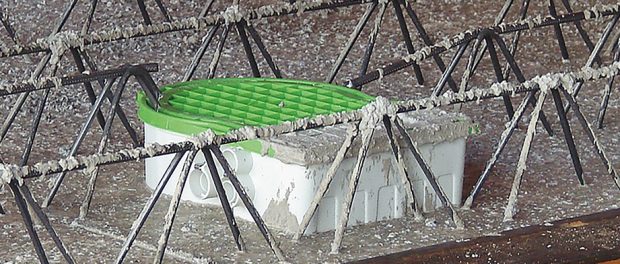
For the enclosures that protect and house electrical terminals and junctions, sockets, switches, and devices, meeting the demands of pre-fabricated concrete construction requires specific characteristics. Enclosures must prevent ingress of concrete during the pour, and while galvanized boxes and conduit ensure protection, sealing the boxes and conduit is time-intensive which equals high labour cost and is a less flexible approach. Today, across most construction projects, even when fire protection and high impact resistance are required, plastic-based enclosures are preferred, manufactured from highly durable materials such as polycarbonate.
With the required ingress protection and impact resistance, plus features such as a diaphragm system that seals around the conduit after installation, our recyclable Polypropylene products provide the solution without the time and cost of additional sealing.
Precise mounting
Crucial to enclosure installation is that they are securely anchored ahead of casting the concrete to prevent significant movement during the pour. With Spelsberg’s IBT system, precise mounting to the formwork is achieved with high strength magnets. While building designers might leave an enclosure movement tolerance of 10mm after the pour, those working with Spelsberg enclosures have reported movement down to just 3mm or less.
Faster installation
Thanks to the installation accuracy achievable with this kind of Polypropylene enclosure, the matching flexible conduit doesn’t require the same level of installation precision as galvanized cable management, which also makes it much quicker to fit. With Spelsberg’s IBT design, instead of handling conduit pre-attached to the enclosure, the conduit is added and connected after the enclosure has been secured, and pushing the conduit through its entry point locks it into position and forms a seal.
After casting, the enclosure’s protective face can be left in place ready for transportation to site where it will be cut away, ready for installation of first-fix electrics.
Cast-in-place
Despite the advantages of pre-cast concrete towards the goals of MMC, cast-in-place techniques might still be needed when flexibility is required. In this situation, maintaining the position of enclosure placement during the cast is even more important, where getting it right first time is crucial to avoid time-consuming rework. As with installation for pre-cast construction, strong magnets can secure the enclosure in place when the shuttering is Metal.
However, if formwork or a metal base are unavailable as anchor points, Spelsberg’s IBT enclosure can be installed with a nail fitting when the shuttering is wooden. While this takes slightly longer to install, it saves time in the long-term by preventing any movement. Again, the conduit can then be simply connected to the enclosure ahead of the cast.
While the IBT and IBTronic enclosures for integration of luminaires, speakers and electronics allow a range flexible installation options, this can be extended with customisation. For example, Spelsberg UK’s in-house customisation team can design and provide options such as integrating multiple British Standard sockets, or adding additional entry points for power, data and communications cables.
Meeting construction targets
While the government is addressing the UK’s housing need, there’s significant demand for new construction projects and redevelopment of public buildings, from schools to hospitals, as well as commercial and industrial development. Properly utilised, MMC methods and modular concrete construction can quickly, economically, and sustainably address these needs. Electrical installation is crucial throughout these projects, which makes selection of the right enclosure and conduit system a vital consideration to maintain these advantages.