

Building better: how we can future-proof our buildings against flooding
By Matt Bradley, Specification Sales Manager – East Midlands at Polypipe Civils & Green Urbanisation.
Extreme weather is becoming increasingly common, and we only need to look at January’s record-breaking 55-day streak of rainfall and the recent May heatwave (in which the UK surpassed its record for maximum temperature in May, reaching 35.1°C in Kew Gardens, London) as examples of the extremes caused by climate change.
Coupled with the rise of the ‘concrete jungle’ and population growth, it’s clear to see that we’re behind. Infrastructure is aging and Victorian-era combined sewer systems can no longer cope with the needs of modern day, urban Britain. With more houses and commercial buildings needing to connect to systems that are already outdated, and our climate becoming warmer and wetter, it’s time to re-think the historical norm and allow our approach to evolve.
So, how exactly do we future proof our buildings against flooding?
Well, the approach needs to combine site planning, structural design, material selection, utilities protection and community-scale resilience. The best method depends on whether the risk is from waterways, coastal storm surge, flash flooding, groundwater rise, or sewer overflow.

Matt Bradley, Specification Sales Manager – East Midlands at Polypipe Civils & Green Urbanisation
Shaping the landscape
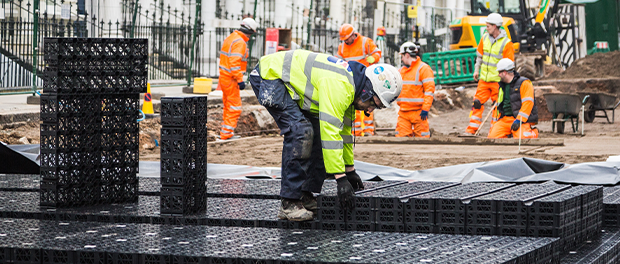
To reduce run-off and help to prevent urban flash flooding, the sites themselves can be used to slow and redirect water.
How? There are a variety of methods and solutions that fit nicely into this category. The first of which are swales – shallow, gently sloped linear channels that transport water. They, along with bioswales (enhanced biodiverse versions, which commonly feature native vegetation and specialised soils) are commonly found in and around new-build housing developments, as the requirements for hitting biodiversity net gain have ramped up in recent years.
Retention ponds – designed to capture stormwater run-off as a permanent pool of water – are also commonly found in new-build housing projects.
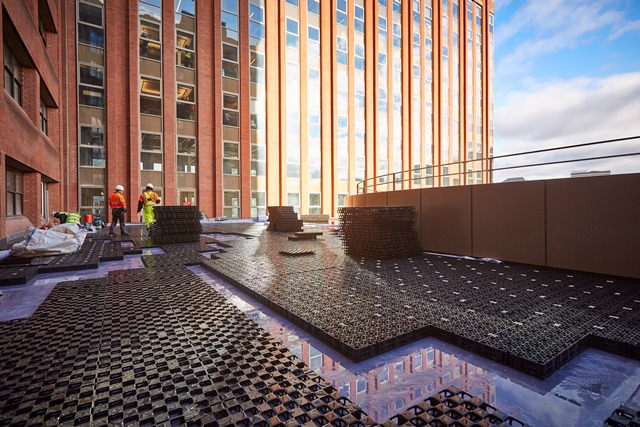
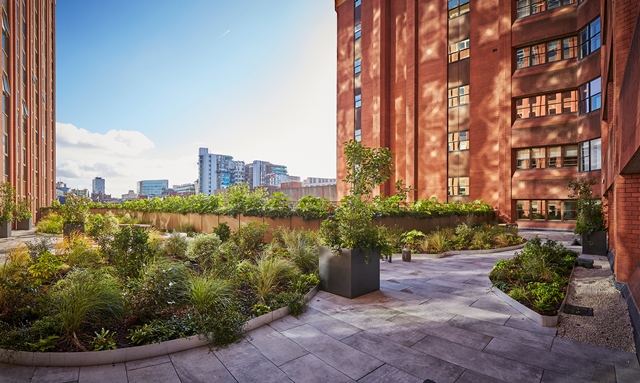
Other effective methods here include the use of permeable paving (which allows water to drain through into the ground below), rain gardens (which provide low maintenance ways of allowing rainwater to slowly soak into the ground, without overwhelming drainage systems) and green or blue-green roofs, which feature vegetation and, in the case of the latter, collect and store stormwater and supports biodiversity.
Not only do all these methods prove effective in terms of water management, but they can all have positive impacts for local communities, too. Residents can take comfort in the fact that the implementation of such solutions reduces the risk of flooding and, therefore, damage to their properties and lives, but they also bring extensive benefits in areas ranging from environmental, wellbeing and community enjoyment.
Going one step further
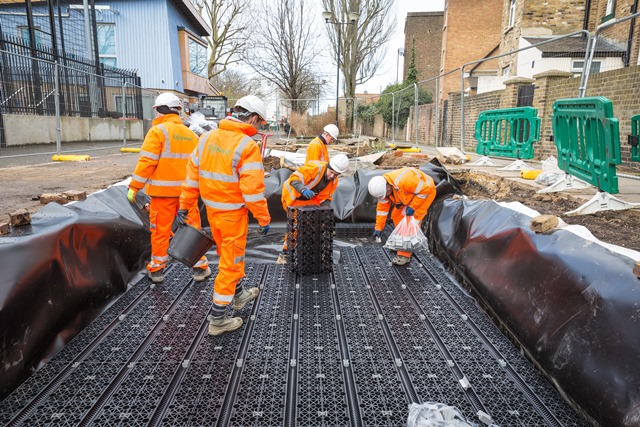
In modern flood-resilient buildings, we’re seeing an increased use of smart monitoring systems to increase capacity in new and existing attenuation tanks and nature-based solutions.
Smart water sensors can offer real-time monitoring and flood detection and can be implemented in various systems – from roofs to sewers and catchpits, and many applications between – to prevent overwhelm and damage to structures and properties.
At Polypipe Civils & Green Urbanisation, our own smart system, Polysync, works with our Polystorm and Permavoid geocellular systems, along with a cloud-based control system, to forecast weather events to optimise water volumes stored in attenuation tanks. It will forecast weather activity and then instruct the tanks to either reduce or maximise their stored water to accommodate rainfall or to maximise potable water storage for use in the event of a drought.
Elsewhere, ‘smart’ is being increasingly used for automated flood barriers, shut-off valves and weather-linked building management systems.
These systems are proving to be game-changers in terms of providing real-time data – which can enable real-time decision making – to the end user.
The planning switch
While it’s great to see the emergence of so many new (and largely nature-based) approaches – such as mangroves, wetlands, rain gardens, tree pits and planters – in the mainstream, we can’t negate the importance of bringing our planning approaches in line with today’s climate.
Many flood maps are outdated because rainfall intensity and sea levels are changing. We’re used to planning based on historical weather, but it’s increasingly important that we design beyond the current code minimums.
In this sense, good future-proofing should consider: 100-year climate projections, plus a 30 or 40 percent scope for climate change impact; sea level rise scenarios; intense rainfall events, and compound flooding (storm surge and rainfall together).
Neighbourhood-scale resilience
It’s also imperative that we consider the wider picture. It’s fantastic to see the implementation of these solutions, but a single flood-proof building can still fail if the surrounding infrastructure isn’t sufficient.
The UK’s aging water infrastructure is under strain and, one year into AMP8 (the eighth, and current, asset management period for the UK water industry), the pressure is on for our sector to deliver.
In this cycle, local councils and water authorities are – rightly – investing in upgraded storm sewers, restored wetlands, tidal barriers and water reuse and urban water management.
AMP8 is and will continue to bring change to the sector but, ultimately, to truly prepare our infrastructure for the environmental challenges and risks of both today and tomorrow’s world, collaboration is an absolute necessity. Joint efforts, methods and approaches will set us up for long-term resilience.
Learn more about how Polypipe Civils & Green Urbanisation are creating sustainable living: www.polypipecivils.com