

Serge Ferrari Names The “7TH MATERIAL” To Bring Technical Membranes Into The Construction Materials Family
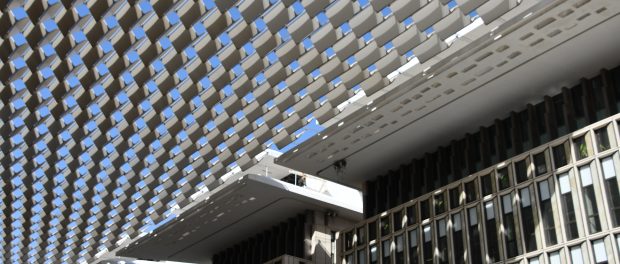
Used for nearly fifty years in architecture and construction, technical membranes have until now mostly been categorized among so-called “lightweight” materials. With the 7TH MATERIAL, Serge Ferrari proposed on Thursday, September 24, 2026, during an international address (see Replay), to give it a name, a scope, and a place alongside the major material families that structure the vocabulary of building design.
The ambition is not to launch an additional product or reserve a proprietary trademark. It is to make a family of materials, its performance, and its accompanying expertise visible, so that architects, engineers, design offices, client representatives, builders, and technical bodies can integrate it earlier in their design choices.
From mass to behavior
Construction has long associated performance with mass, thickness, and the addition of successive layers. The technical membrane introduces a different logic: generating performance through the behavior of a surface placed under tension and through the functions it fulfills.
It does not replace stone, wood, concrete, metal, or glass. It works alongside them. Its lightweight nature helps lighten certain structures; its ability to filter, protect, or absorb can limit the need for corrective systems; its flexibility and tensioning turn geometry, wind, sun, light, and acoustics into design parameters.
Thus, the material no longer intervenes only at the end of the design process as a technical response: it can help shape the project from its inception.
“The membrane is no longer something you specify at the end of a project. It participates in the search for the solution right from the start. You don’t specify it. You design with it.” emphasizes Nick Tyrer, architect and designer, BDP Pattern.
One surface, multiple functions: project evidence
This logic is measured as much by the amount of material used as by the concentration of functions on a single surface:
- At the M9 Museum in Mestre, designed by Sauerbruch Hutton, an interior membrane lets 41% of light pass through and achieves an acoustic absorption coefficient $\alpha_w$ of 0.65. The same surface thus contributes to both daylighting and acoustic comfort.
- At The Camp in Aix-en-Provence, designed by Corinne Vezzoni & Associés, nearly 7,000 m² of membrane create a canopy over the outdoor spaces, contributing to solar protection.
- In Msheireb, Doha, a project by Mossessian & Partners, a retractable roof consisting of 1,080 panels covers the public square and adapts its protection to climatic conditions.
- At Dalt Vila in Ibiza, 137 kg of fabric cover a courtyard located within a UNESCO World Heritage site, requiring minimal weight load on the existing structures.
Less material, documented performance
One square meter of membrane weighs between 380 g and 1.6 kg. A well-designed membrane roof can be up to ten times lighter than a solution built with conventional materials, depending on its geometry. Based on a 50-year life cycle analysis of a solution studied by the group, the reported footprint is approximately 20 kg CO₂ eq./m², compared to around 75 kg CO₂ eq./m² for the reference metallic solution.
“For four thousand years, building lighter was a choice. Today, it has become a necessity.” Nic Goldsmith, architect, engineer, and pioneer of lightweight structures.
For solar protection, certain membrane solutions can block up to 97% of solar energy before it passes through glass. In the commercial building scenario evaluated according to ISO 52022-3, integrating an automated textile blind reduces cooling requirements from 60.2 to 29.8 kWh/m²/year.
An open category to evolve design specifications
By naming the 7TH MATERIAL, Serge Ferrari aims to facilitate the recognition of technical membranes in architectural specifications and in dialogue with design offices, clients, insurers, and technical organizations. The initiative is intended to go beyond the group’s own products and be shared across the entire industry: manufacturers, fabricators, engineers, and architects.
To gain recognition, this new family must rely on a common language, explicit measurement methods, and comparable data. Serge Ferrari announces its intention to document these performance metrics, their sources, and their limits, enabling designers to evaluate membranes on an equal footing with other construction materials.
“We are not launching a new product; we are giving a name to a material family that is already present in architecture but still insufficiently recognized. With the 7TH MATERIAL, we want to show that performance can also come from the behavior of a surface, its lightness, and its ability to combine multiple functions. This category is intended to be open, documented, and shared across the whole industry.“
Sébastien Baril, CEO of Serge Ferrari Group
Looking differently at what a material can do
With the 7TH MATERIAL, Serge Ferrari invites the sector to shift the question: no longer just “what is this material made of?”, but “what does it allow the building to do?”. A way to expand the scope of design with a category of materials that combines lightness, adaptability, and functional density.
A category documented here: https://www.sergeferrari.com/en/7thm-hub/