

Industry First: Exoworks and Dawonia Project Awarded First-Ever Serial Retrofit Certification

Milestone provides independent proof that industrialized, prefabricated retrofits can meet Europe’s most rigorous green-building standards, a scalable blueprint for decarbonizing the continent’s ageing housing stock
A joint serial retrofit project by ecoworks, Germany’s pioneer in industrialized net-zero renovations, and residential real estate company Dawonia has become the first serial retrofit project ever to receive a certification.
The milestone carries significance well beyond Germany. Buildings account for around 40 percent of the EU’s energy consumption and more than a third of its energy-related greenhouse gas emissions, and under the revised EU Energy Performance of Buildings Directive, member states must sharply accelerate the renovation of their worst-performing housing stock. Serial retrofitting, using digitally planned, factory-prefabricated facade and roof elements to bring apartment buildings to net-zero standard within weeks, is regarded as one of the few approaches capable of delivering renovations at the required speed and scale. The Nuremberg certification now provides the first independent evidence that this industrialized method can also satisfy the most demanding sustainability certification standards.
“We are delighted that the NH class unlocks a repayment grant of 5 percent under the KfW funding scheme for this project and, prospectively, for further follow-on projects with our clients,” says Emanuel Heisenberg, founder and CEO of ecoworks.
Awarded in Silver by the German Sustainable Building Council (DGNB), its Europe’s largest network for sustainable construction together with the German federal government’s Sustainable Building Quality Seal (QNG). The Nuremberg project is also the first serial retrofit to qualify for the sustainability class (NH class) of Germany’s Federal Funding for Efficient Buildings programme (BEG).
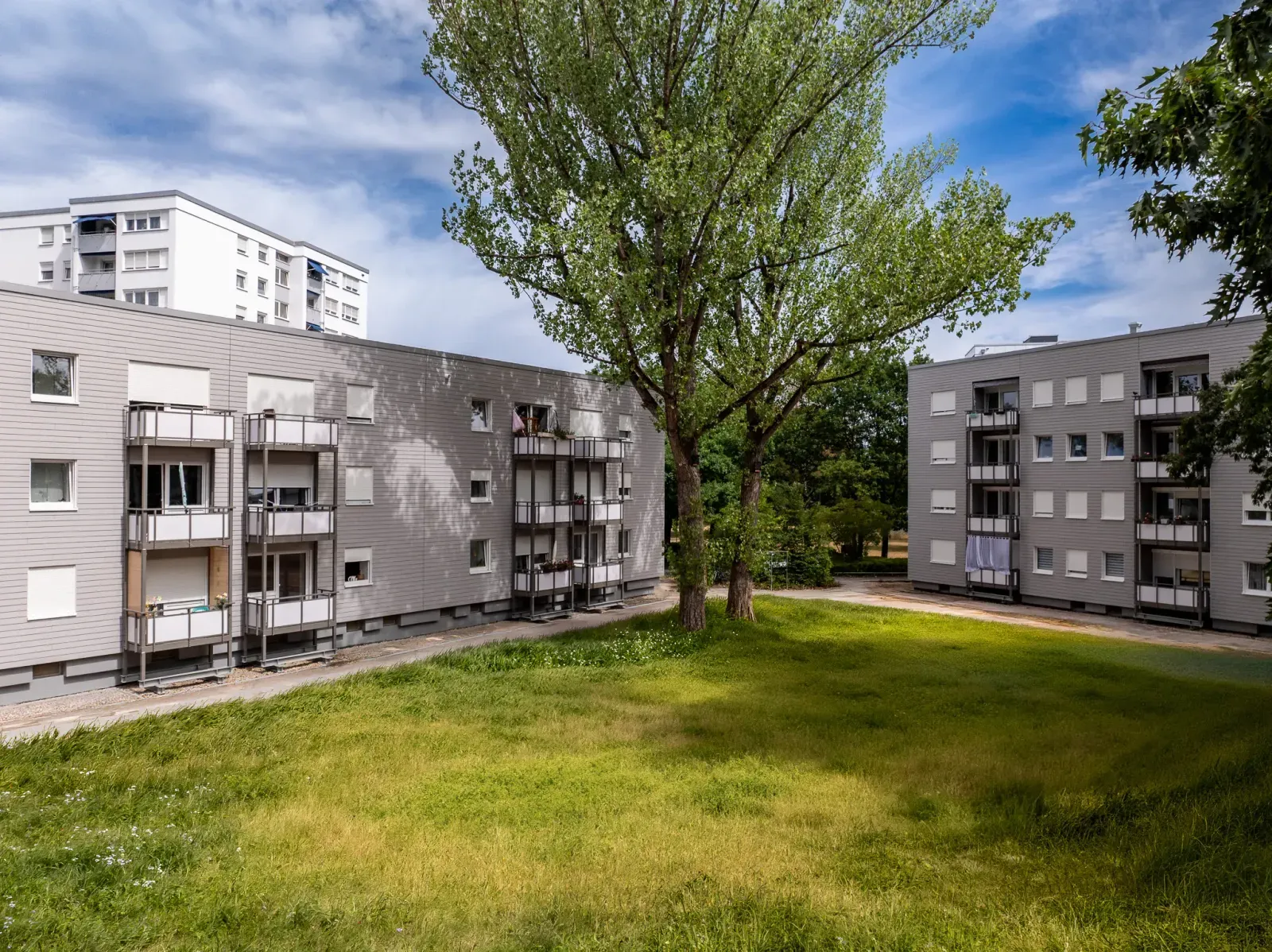
From retrofit project to certified sustainability reference
The joint ecoworks and Dawonia project comprises three multi-family buildings in Nuremberg, originally constructed in 1966, with 72 apartments and a total living area of 4,799 m² (approx. 51,700 sq ft).
“The successful delivery of the demanding KfW Efficiency House 55 NH standard by the two project teams fills us with great pride — a result that is so far unmatched,” says Sebastian Gefeller, COO of Dawonia.
The DGNB Silver certification, including the QNG seal, confirms this ambition: with an overall fulfilment score of more than 50 percent and a top score of around 76 percent in the ecology category, the project sets a new benchmark for serially retrofitted existing buildings.
“Serial retrofitting offers great potential to bring sustainability standards into the building stock faster and more broadly. The high degree of prefabrication and standardization makes it possible to implement quality requirements systematically and to demonstrate them transparently through certification. We therefore see considerable potential to safeguard the quality of renovations through certification processes and to scale sustainable solutions with the help of serial technologies,” says Dr. Christine Lemaitre, CEO of the DGNB.