

How the UK Rental Market is Supporting the Decarbonisation of Project Sites
Amid ongoing market uncertainty and the pressures to reduce emissions, Atlas Copco Rental UK and Ireland outlines the ways in which temporary equipment hire over that of permanent asset ownership is providing reliability, security and sustainability.
When considering on-site compressed air requirements, diesel-powered compressors are often still regarded as the preferred solution for construction and industrial applications. This is often due to their ability to operate independently of the electrical grid, deliver high-pressure air, and their portability.
However, there is no getting away from their reliance on fossil fuels and the emissions they produce such as CO2 and NOx which are counterproductive to decarbonisation efforts. As a result, electric compressors are increasingly being considered as an alternative. These units offer zero emissions (not withstanding that they need to be plugged in to operate, which can produce CO2) and can provide Class Zero oil-free air when required.
Why don’t sites immediately swap to electric?
It is because there is still the tendency to believe that electric cannot provide the flexibility and pressure required for a demanding environment.
That’s no longer the case. Available to the rental market are portable electric air compressors that, like their diesel-powered counterparts, can be easily moved around site without specialist lifting or transport capabilities. They are capable of delivering high flow rates up to 1000 cfm, providing sufficient capacity to continuously run high-demand pneumatic tools for example.
In addition to matching the performance and mobility of diesel compressors, electric models offer the advantages of being carbon emission free, delivering best-in-class energy efficiency and silent operation.
Although we cannot disregard the fact that electric air compressors do require access to the grid. When this isn’t possible, there are alternatives depending on site requirements that don’t solely rely on diesel.
When operating without access to reliable power, what are the eco alternatives?
A diesel-powered Stage V unit is ‘cleaner’ compared to older models and can reduce particle matter and NOx by up to 50 per cent, making it suitable for use in full compliance of European Low Emission Zones. These units can also support sustainability efforts as through upgraded engine technology and electronic controls the units have a lower fuel consumption than older units. A further benefit of the unit, and adding to why they are a viable alternative to electric when there is no access to power, is that that are compatible with HVO biofuel blends.
HVO (hydrotreated vegetable oil), is a new generation biodiesel produced from recycled vegetable oils and fats – mostly the waste products of the fish and meat industry. You may recognise it as it is widely mentioned being in use in the UK by a fast-food restaurant to fuel its delivery trucks.
It’s 100 per cent fossil-free, non-toxic and carbon neutral, because it’s a recycled product. HVO also burns cleaner than diesel. Therefore, it can ensure equipment runs carbon-free and lowers the emission of NOx and particle matter. And, if access or cost to HVO becomes a challenge it can be blended or topped up by diesel. Enabling significant energy and emission savings without the risk of operational downtime.
Because of this, HVO also opens up the possibility of an electric air compressor being powered by a Stage V generator and a hybrid energy storage system.
How to utilise rental for a hybrid approach to project sites
More and more, energy storage systems are being utilised on construction sites to power electric machinery and enable the fast recharging of electrified equipment.
Their use either as a full solution or hybrid leads to less fuel consumption, reduced CO2 emissions, and a benefit in particular to metropolitan areas is their quiet operation.
As batteries can be paired with a generator it means that the generator only runs to charge the battery when it gets low. This can lead to significant fuel and noise reductions on site.
The benefits of rental mean that sites can access the most up to date technology and fuel and energy efficient units without significant upfront costs. Especially when it comes to fuel alternatives and battery technology where advancements come in quick succession.
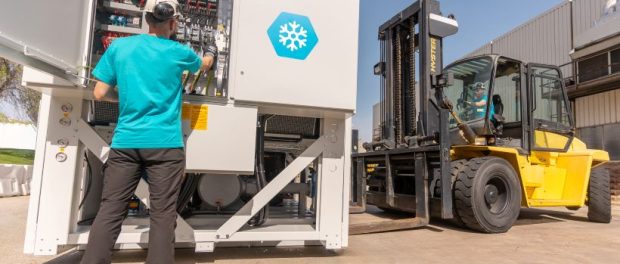
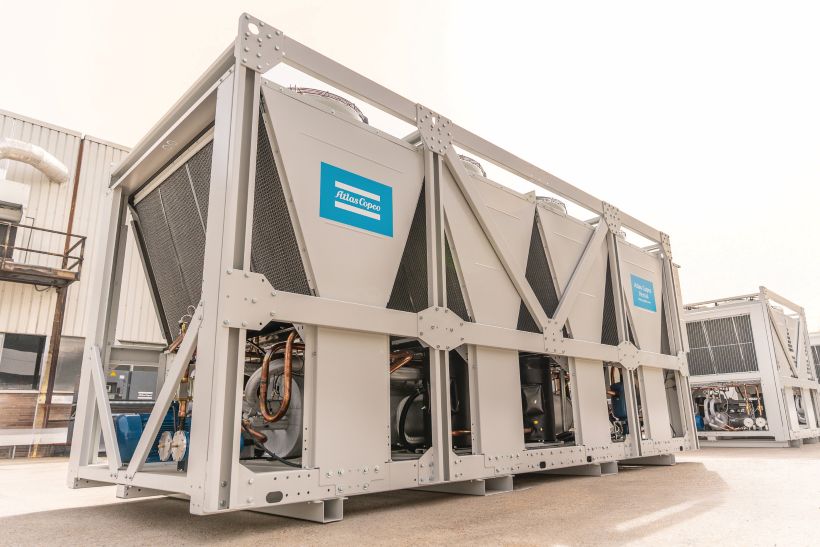
Even if you take recent and more often reoccurring heat waves in the UK, the rental market can support with the supply of chiller units. They are becoming more widescale in use on UK sites because of hotter climates as they allow for scalable climate control on site whilst the permanent HVAC system takes over and supports process cooling and finishing processes. In addition, they can provide a safer and more comfortable operating environment for workers.
To minimise environmental impact and reduce carbon footprint, look for a unit that uses low Global Warming Potential (GWP) refrigerants such as R32. And one that utilises technology to enable close monitoring and scalability so that the unit can operate reliably and efficiently.
The benefit of an evolving hire industry
In recent years, the hire industry itself has undergone its own evolution. It too has taken on a responsibility to not just supply equipment.
Selecting and working with the right rental organisation can lead to a full-scale operational partnership where advice and guidance can be provided on managing complex on-site logistics. A good partnership offers access to 24/7 emergency response, onsite installation, service and maintenance support and where required technical training. Rental organisations are also working hard to develop fuel and energy efficient equipment that is specific to requirements, and that meet global standards and compliances. You can’t get that type of support from a one off, off-the shelf purchase.