

H-UKR decarbonised cement means it’s time to reassess the need for expensive Carbon Capture and Storage projects, says innovator CemBlend
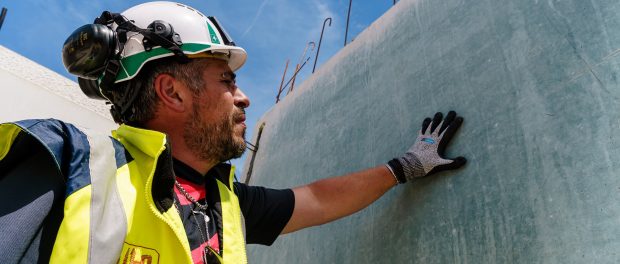 H-UKR decarbonised cement is manufactured cold, using industrial co-products and activators from the chemical industry, ultimately producing clinker free, low-carbon concretes and concrete products.
An innovative company that has signed an exclusive agreement to market the groundbreaking decarbonised Hoffmann Green H-UKR cement in the UK and Ireland is calling on industry chiefs to reassess the value of expensive ‘Carbon Capture and Storage’ (CSS) schemes.
Midlands-based CemBlend, which produces bespoke blends of cementitious powders to create more sustainable bespoke solutions for construction and infrastructure, signed a landmark licensing agreement in December to become the exclusive partner for Hoffmann Green Cement in the UK and Ireland – partnering (double partnering but I can’t think of a better word than joining) with a pioneering company that is leading the way in creating a more sustainable built environment.
The agreement means CemBlend is supplying products such as Hoffmann Green’s 0% clinker decarbonised cement, H-UKR – which has a carbon footprint that is a sixth of traditional cement.
Decarbonising the cement manufacturing sector is seen as a key step in tackling climate change, as its production is responsible for up to 8% of global CO2 emissions each year.
H-UKR is manufactured cold, using industrial co-products and activators from the chemical industry, ultimately producing clinker free, low-carbon concretes and concrete products.
While products like H-UKR create far less CO2 during production, CSS instead captures CO2 during manufacture and stores it, often underground.
CemBlend director Simon Boulter said: “The cement sector is making great strides to decarbonise, with genuine breakthroughs such as H-UKR, a ‘green’ cement which is manufactured cold and available now at scale.
“H-UKR has a lower ecological impact at the production stage, creating less CO2 in the first place.
“This is surely a better alternative to Carbon Capture, which still allows CO2 to be created, before storing it away. We think, with solutions like H-UKR available, the sector can reassess the wisdom of investing in CSS.”
Director Matt Cunningham said: “As it requires huge capital investment, CCS adds significant costs to the business of making cement – in some cases hundreds of Euros per tonne – which are either passed on to the customer or even worse subsidised by the taxpayer, which is the position that the cement producers and MPA are lobbying for.
“With tried and tested products like H-UKR available, we should be questioning if this is the correct route to decarbonisation.
“Clearly, it’s better to not create carbon in the first place, rather than having to store it away for future generations to deal with. After all, Isn’t Carbon Capture like calling landfill ‘Waste Capture’?”