

Cutting hand-arm vibration starts with the tool you pick up

On most sites, hand-arm vibration comes from a familiar group of tools: grinders, disc cutters, chipping hammers, needle scalers and breakers. Construction is one of the sectors where the Health and Safety Executive describes exposure as particularly high, and yet tool choice still tends to be settled on price and availability long before anyone thinks about the operator’s hands.
Buyers who do want to weigh vibration have plenty of information to compare. Industrial suppliers such as Atlas Copco ITBA group their grinders, sanders, drills, saws, riveting hammers and percussive tools under a single material removal range, and Atlas Copco presents reduced vibration and noise levels and ergonomics as selling points for those tools. Claims like these only matter, though, when they are tested against the actual work, which is where the UK rules give buyers a useful framework.
What the regulations actually ask of employers
The Control of Vibration at Work Regulations 2005 set an exposure action value of 2.5 m/s² A(8) and an exposure limit value of 5 m/s² A(8), and the limit is a line that should not be crossed. Once a worker reaches the action value, the employer is expected to bring in technical and organisational measures to reduce exposure, and regular exposure at or above that level also triggers health surveillance.
HSE’s rule of thumb gives a sense of how quickly those numbers arrive. Action is likely to be needed if people regularly use hammer-action tools for more than about 15 minutes a day, or some rotary and other tools for more than about an hour. On a steel fabrication job, a precast yard or a refurbishment where concrete is being scabbled back, those durations can be reached well before the end of a shift.
Turning HSE guidance into buying and site decisions
HSE’s guidance on protecting workers from hand-arm vibration is practical, and most of it lands on decisions a site manager or buyer makes anyway. The main points translate into everyday habits like these:
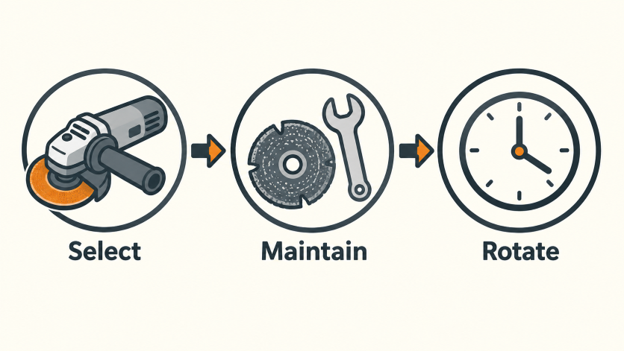
- Choose the lowest-vibration tool that can still do the job efficiently, and avoid undersized or underpowered kit, because a slow tool simply stretches the exposure time.
- When replacing equipment, compare manufacturers’ vibration data, let the people who will use it trial the models, and check that any vibration-reducing features work when the tool is used as intended.
- Keep consumables sharp and replace grinding wheels and chisels once they wear, since blunt accessories make the job longer and rougher.
- Follow a planned maintenance programme in line with the manufacturer’s recommendations, so vibration does not creep up unnoticed as a tool ages.
- Split heavy tasks into shorter periods and rotate operatives on tools that are in frequent use.
- Keep workers warm and dry to support circulation, while remembering that gloves help with warmth but should not be relied on for vibration protection.
One example HSE gives is worth repeating on any M&E or fit-out job: a diamond-tipped rotary bit cuts holes in brickwork with less vibration than a tungsten-tipped rotary-hammer bit. Small swaps like that cost little and add up across a team.
Fitting tool choice into the wider risk picture
Vibration is rarely the only hazard on a task involving grinding, drilling or breaking out. Retrofit work is a good illustration, because older buildings can hide materials that should never be disturbed without a survey. As this magazine has reported, retrofit at scale has an asbestos problem that many programmes are not budgeting for, with drilling through textured ceiling coatings named as one way it gets disturbed. The tool decision belongs in the same conversation as surveys, dust control and noise.
For contractors reviewing their fleets, the most useful step is usually a simple one: list the tools that drive the highest daily exposure, check their vibration data and condition, and replace the worst offenders first. Health surveillance results then show whether those changes are reaching the people holding the tools.