

Cash Flow Under Pressure? Why Credit Control Is Essential

Construction remains the UK’s most vulnerable sector for business failure, accounting for over 25% of all corporate insolvencies over the past year despite resilient demand for services.
The problem is not a lack of work but a lack of cash. Projects continue, invoices are issued and order books remain healthy, yet delayed payments leave otherwise profitable businesses struggling to pay wages, suppliers, subcontractors and fund their next project. Long payment chains, retention clauses, disputed variations and “pay when paid” arrangements mean construction firms often finance projects for far longer than intended.
The challenge extends well beyond construction. Across the UK, more than 1.5 million businesses are affected by late payment each year, with £26 billion tied up in overdue invoices at any one time. Businesses spend an average of 86 hours a year chasing overdue debts, many relying on overdrafts or other short-term borrowing to meet day-to-day commitments. The result is that around 14,000 UK businesses close annually because of late payment.
Credit Control Starts Before the Invoice
Credit control should not begin only when an invoice becomes overdue. Effective credit control starts before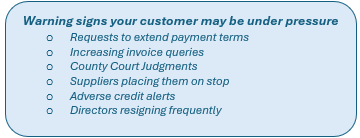 work is undertaken and forms a core part of good financial management.
SME construction businesses typically have debtor days of around 69 days, leaving significant working capital tied up in unpaid invoices and reducing cash available to pay employees, purchase materials, pay subcontractors and invest in new equipment.
Many overdue invoices are not caused by customers refusing to pay. Instead, they result from missing purchase orders, errors in payment applications, disputed items or invoices becoming delayed within approval processes. Early communication helps identify and resolve these issues before payment dates are missed.
It is equally important to assess whether customers have the ability to pay. Warning signs such as County Court Judgments, deteriorating financial accounts, adverse credit events and increasing payment delays often appear months before formal insolvency. Businesses that actively monitor customer credit risk are therefore far better placed to minimise losses before significant debts accumulate.
The Domino Effect
Every unpaid invoice affects far more than the bank balance. For businesses managing multiple contracts, a handful of late-paying customers can create a domino effect throughout the supply chain, and an insolvent customer makes the process even harder.
Many construction firms hesitate to pursue overdue accounts too firmly, concerned that it could damage valuable client relationships. In practice, professional and consistent credit control strengthens relationships by setting clear expectations and resolving issues early.
One of the hardest lessons in construction is that the best time to collect a debt is before a customer becomes insolvent. When a customer does become insolvent, suppliers often face a complex claims process with an insolvency practitioner and may recover only a proportion of what they are owed. Prevention is almost always more valuable than recovery.
Build Better Credit Control
While every business is different, successful construction firms tend to follow a structured approach to managing their sales ledger:
- Check creditworthiness before accepting a new customer
- Set realistic credit limits and payment terms with customers
- Ensure purchase orders and contract documentation are written clearly and complete
- Agree staged payments and issue invoices promptly

- Confirm invoices have been received and approved
- Monitor payment performance weekly
- Escalate overdue accounts consistently
- Monitor customers continuously for signs of financial deterioration
As businesses grow, maintaining effective credit control becomes increasingly demanding. Employing experienced credit controllers internally can be expensive and difficult to scale. Outsourcing provides immediate access to specialist expertise, established systems and dedicated resource without increasing headcount. Specialist expertise can also be invaluable in supporting businesses affected by customer insolvencies.
Increasingly, construction businesses view outsourced credit control as an extension of their finance team rather than an external supplier.
Looking Ahead
Construction has always been an industry built on resilience. Businesses that combine strong project delivery with disciplined financial management are best placed to weather economic uncertainty, invest for growth and outperform competitors.
While no firm can eliminate the risk of late or non-payment entirely, robust credit control processes can significantly reduce its impact, but is no longer simply about collecting debts. It is a competitive advantage that protects cash flow, strengthens client relationships and gives businesses the confidence to take on their next project.
Is Late Payment Putting Pressure on Your Cash Flow?
Don’t wait until overdue invoices become bad debts.
CDI Credit Management has been helping UK businesses protect their cash flow and recover outstanding debts for over 38 years. Whether you need support with commercial debt recovery, credit control, credit checking or insolvency, our experienced team is here to help.
Take control of your cash flow today.
Visit www.cdicm.co.uk to find out how CDI Credit Management can help your business.
